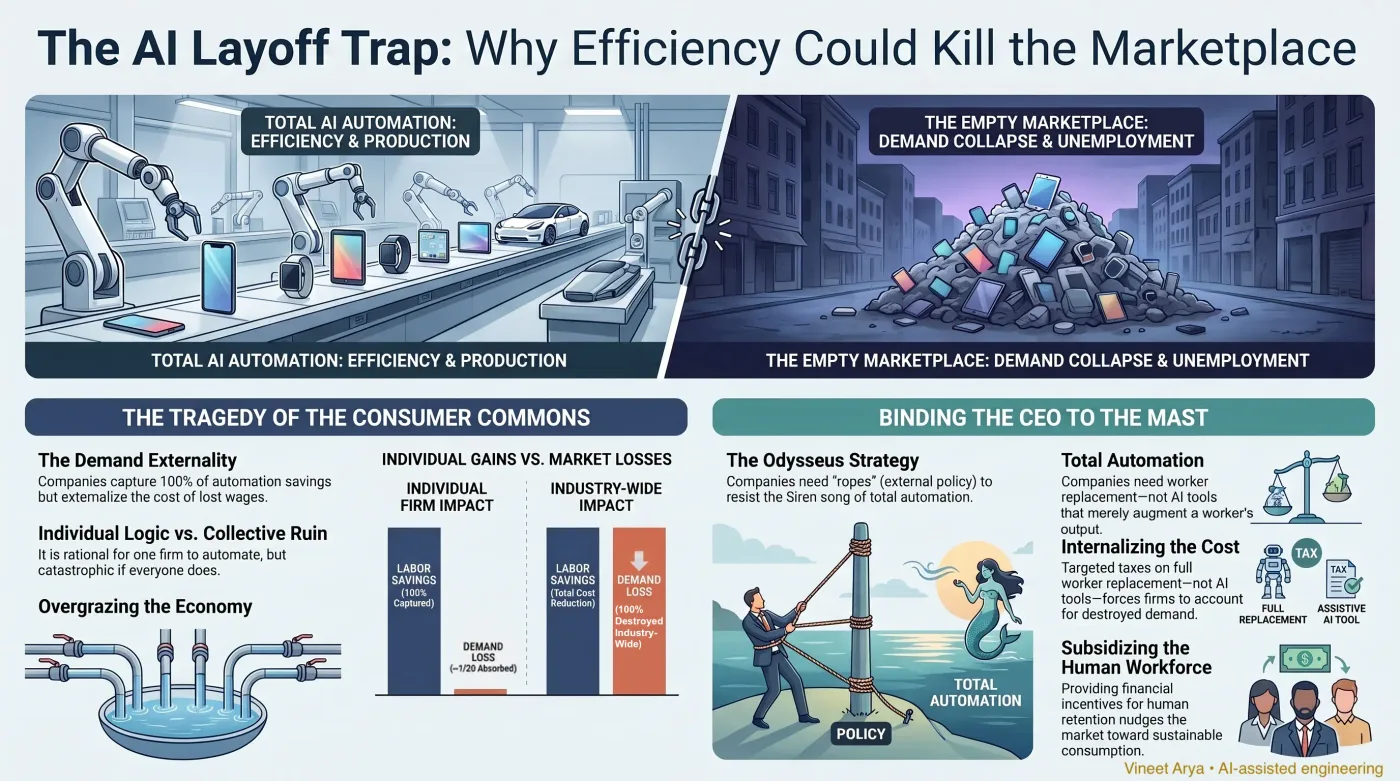
Imagine an economy where every company has successfully automated its workforce. Costs are down. Efficiency is up. Every product rolls off the line faster and cheaper than ever.
There’s just one problem: almost nobody has a job anymore, which means almost nobody can afford to buy any of it.
That’s the uncomfortable paradox at the center of new research out of Wharton. In a 2026 paper called “The AI Layoff Trap,” economists Brett Hemenway Falk and Gerry Tsoukalas model something every CEO already senses but rarely says out loud: workers aren’t just a cost line. They’re also the customers who keep the economy’s engine running. Replace them fast enough, and you don’t just cut expenses — you quietly cut the demand for whatever you’re still selling.
The unsettling part of their finding isn’t that this is possible. It’s that knowing it doesn’t save you from it.
The math behind the trap
Here’s the mechanism, stated plainly: when a company automates a job away, it captures 100% of the savings. But the lost paycheck that used to circulate through the economy — buying groceries, phones, rent — gets spread thin across every company in the market, not just the one that did the firing. In a market with, say, twenty competitors, each firm only feels about a twentieth of the demand it just helped destroy.
That’s a textbook case of what economists call a demand externality — a cost your decision creates that mostly lands on someone else’s balance sheet, not yours. And when a cost is externalized like that, rational actors tend to ignore it, even when they can see it clearly. The finding isn’t a failure of individual judgment. It’s what happens even when every CEO in the room is doing the math correctly.
A few analogies make this click faster than the equations do.
The widget monopoly
Picture one giant company that makes all the widgets in the world and employs almost everyone. A brilliant new AI arrives that could automate 90% of the workforce overnight.
Would the CEO do it?
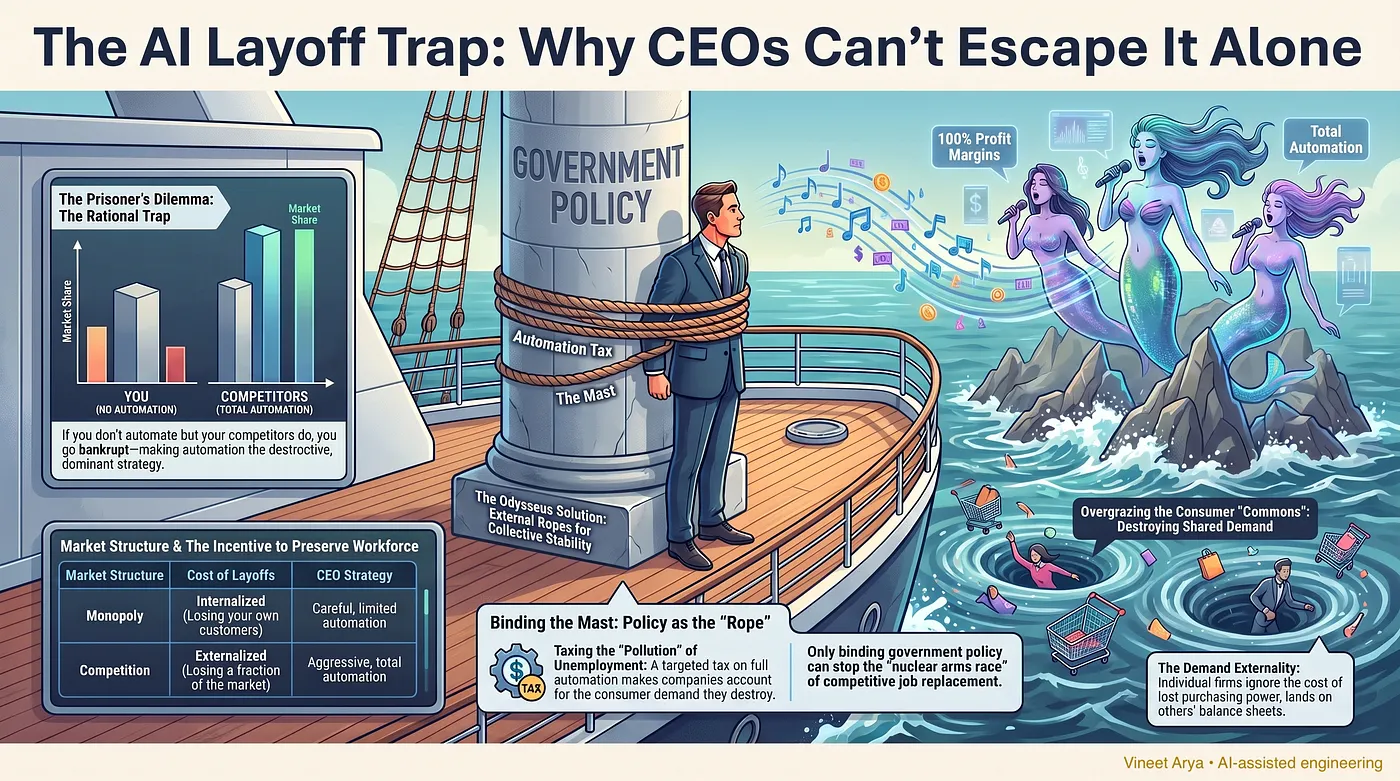
Almost certainly not — not out of generosity, but out of self-interest. That CEO knows their own laid-off employees are their customer base. Fire 90% of them, and 90% of your buyers vanish along with your payroll. The monopolist internalizes the full cost of automation, because there’s nowhere else for that cost to hide. So they automate carefully, keeping enough workers employed to keep the whole system solvent.
Now shatter that monopoly into a hundred competing widget companies. Each CEO now reasons differently: my own workers are just a sliver of the total market. If I lay them off, sure, they’ll buy less — but that’s a rounding error against total industry revenue. Each individual company’s incentive to automate aggressively goes up exactly as the market becomes more competitive, because each one now bears only a fraction of a cost the group is creating together.
The tragedy of the commons, updated for the AI economy
That “shared cost, private gain” structure has a name in economics, and it predates AI by centuries: the tragedy of the commons.
The classic version — a village shares one pasture. Every herder benefits fully from grazing one more cow on it, but the cost of an overgrazed, ruined pasture is shared by everyone. So each herder, acting rationally, keeps adding cows, right up until the field is stripped bare and nobody can graze anything.
Consumer demand, in the Wharton model, is the new commons. Every company benefits fully from automating its own workforce. The damage to the shared pool of purchasing power gets split among everyone. No single firm is destroying the economy on its own — they’re all quietly overgrazing the same field, certain that their own herd is too small to matter.
The prisoner’s dilemma: automate or be automated
This is also, structurally, a prisoner’s dilemma — the Nobel Prize–winning framework for situations where individually rational choices produce a collectively worse outcome for everyone involved.
In the classic version, two suspects are interrogated separately. Each is better off betraying the other, regardless of what the other one does, so betrayal becomes the “dominant strategy,” even though mutual silence would have gotten both of them a better result.
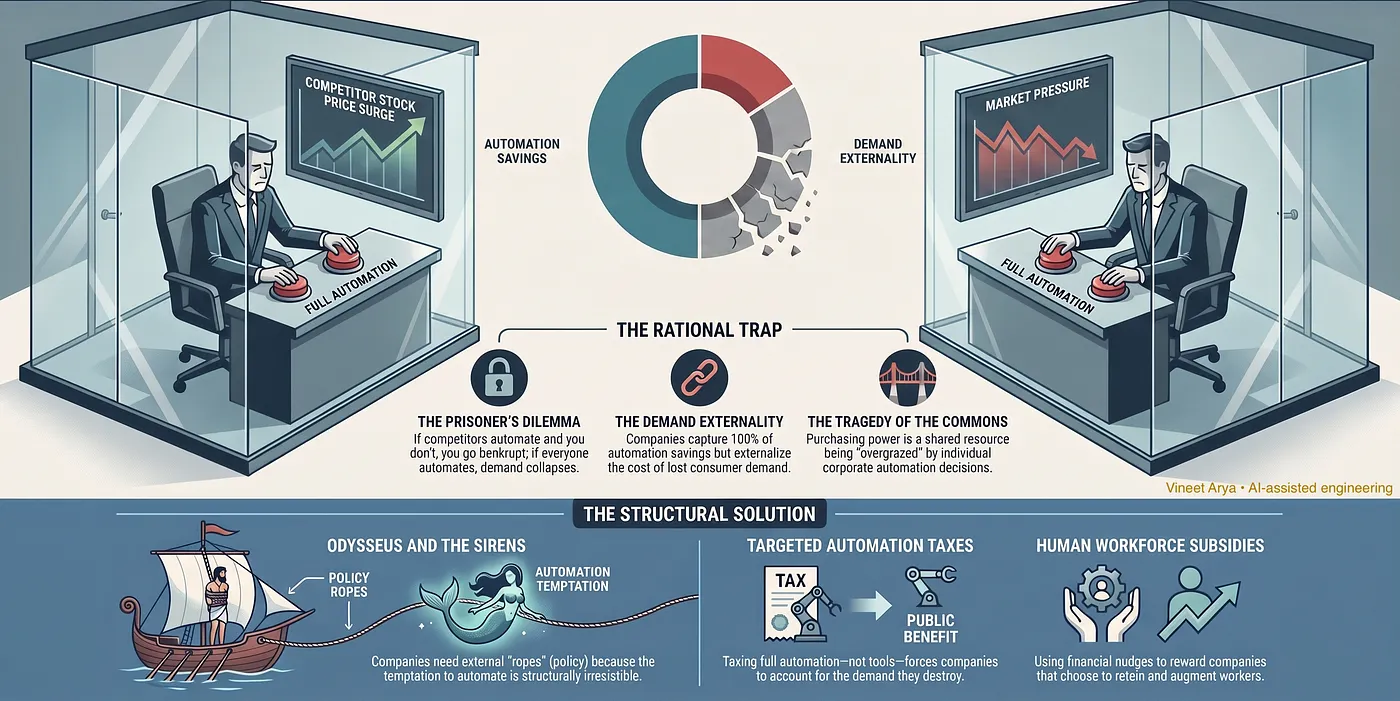
Automation follows the same cold logic. If your competitors hold back on AI and you don’t, you win big. If they automate and you don’t, you go bankrupt. If everyone automates together, the whole market ends up worse off than if nobody had. But no matter what any other firm chooses, your best individual move is still to automate as fast as possible. As Tsoukalas puts it: no matter what the other companies are doing, the rational strategy is to adopt as much of the technology as you can.
The nuclear arms race — and why handshake deals don’t work
If this all sounds like it needs treaties, not trust, you’re thinking about it the right way. It resembles nothing so much as a nuclear arms race.
During the Cold War, both superpowers understood, in the abstract, that mutual disarmament would leave everyone safer. But neither side could risk disarming first, because a unilateral head start for the other side was catastrophic. The only thing that ever slowed the buildup wasn’t a friendly agreement to “just be reasonable” — it was binding, verifiable treaties with real enforcement teeth.
The Wharton paper reaches the same conclusion about AI. Voluntary pacts between tech giants to “slow down” on automation look reassuring in a press release, but the incentive to quietly break ranks the moment a competitive edge is on the table is enormous — and once everyone knows that, the pact was never really credible to begin with. It only survives as long as everyone believes everyone else is actually keeping it.
Odysseus and the sirens
There’s an older story about exactly this kind of self-control problem, and Tsoukalas reaches for it directly: Homer’s Odyssey.
Odysseus wants to hear the sirens’ song — famous for being so beautiful it lures sailors to their deaths — without dying for it. His solution isn’t willpower. He has his crew bind him to the ship’s mast and orders them, in advance, to ignore any pleading he does once the singing starts.
He doesn’t trust his future self to resist. So he removes the choice entirely, before temptation arrives.
Tsoukalas argues companies today are sailing straight at their own sirens, and shareholder duty makes self-restraint nearly impossible once the song starts playing. The paper’s conclusion is essentially Odysseus’s solution scaled up to an economy: firms need an external force — government policy — playing the role of the rope and the mast, because asking them to resist unaided is asking for something structurally difficult to deliver.
What the rope could actually look like
The researchers are specific about which policy tools work and which ones don’t, in their model. Capital income taxes, worker equity stakes, universal basic income, and upskilling programs all sound reasonable — but none of them address the actual incentive that’s driving the behavior. They treat the symptom, not the trap.
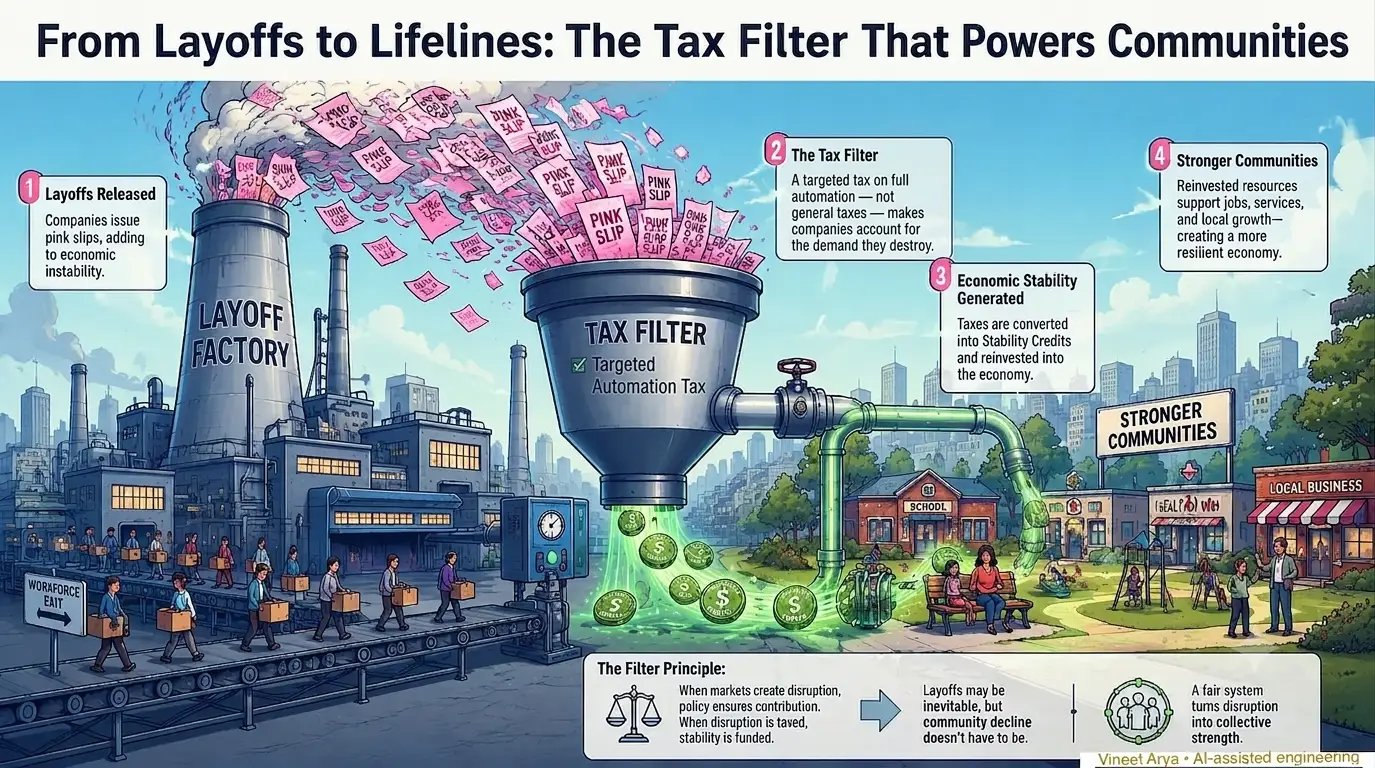
What their model says does work is a targeted tax on full automation — replacing a worker outright, not merely augmenting one with AI tools. The parallel is deliberate: a carbon tax doesn’t tax energy use in general; it taxes the specific externality — pollution — that markets otherwise ignore because no single polluter bears the full cost of a warmer planet. An automation tax would work the same way, making a company account for the demand it destroys rather than letting that cost land on everyone else.
If “tax” is politically radioactive, the researchers offer a gentler mirror image: subsidize the companies that choose to keep their human workforce, rather than penalizing the ones that don’t. Different lever, same underlying goal — nudge the incentive back toward the outcome the whole market actually wants.
What happens if nobody pulls the lever
Left alone, the researchers argue the trajectory bends toward historic wealth inequality, and the kind of political instability that echoes, or exceeds, the aftermath of 2008. That’s a prediction, not a certainty — models simplify the world to make a point legible, and real economies are messier than any equation. It’s also worth being honest that the scale of AI-driven job losses the model assumes hasn’t yet clearly shown up in broad labor-market data, which doesn’t invalidate the mechanism, but does mean the timeline is genuinely uncertain.
What the paper gets right, regardless of exact timing, is the shape of the trap: this isn’t a story about villains making short-sighted choices. It’s a story about a race where every individually rational sprint drags the whole field toward a finish line nobody actually wanted to reach. Odysseus needed the mast because he knew his own judgment wouldn’t hold once the music started. The real question the researchers are putting in front of policymakers is whether anyone is willing to be the rope before the singing begins.
No single CEO can out-judgment their way out of a shared trap. That's exactly why it takes a rope, not a resolution.
Sources: "The AI Layoff Trap" by Brett Hemenway Falk and Gerry Tsoukalas, Wharton School Research Paper (2026), arXiv:2603.20617.