In May 2026, while foreign capital pulled roughly $30 billion out of Indian equities and the Nifty IT index slid toward its worst year since 2008, India’s largest actively managed equity fund did something that looked completely reckless on the surface.
It doubled down on IT.
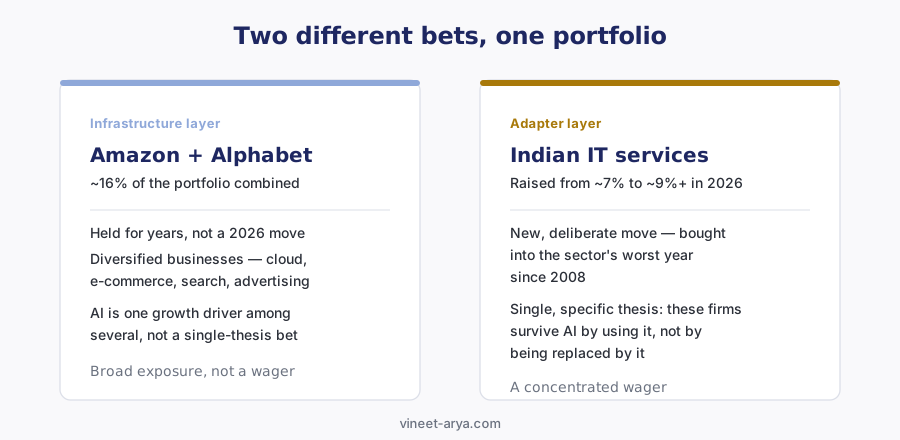
Parag Parikh Flexi Cap Fund — managing ₹1.4 lakh crore in assets — quietly raised its IT allocation from under 7% to over 9% in a single quarter, buying aggressively into a sector the broader market was fleeing.
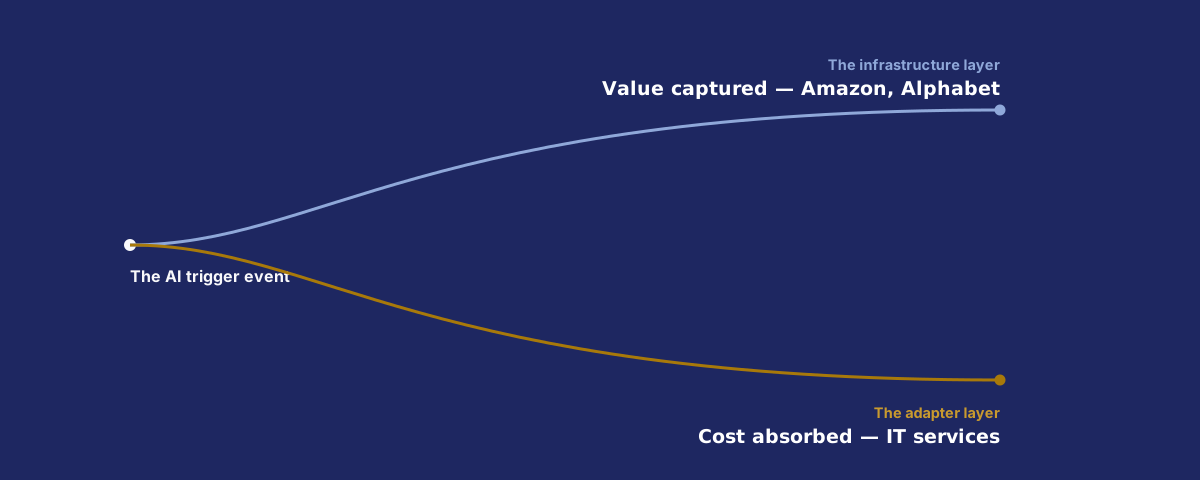
To the casual observer, it looked like a standard “buy the dip” contrarian play. But look closer at the portfolio’s architecture, and a deeper strategy emerges. The fund’s two largest holdings are Amazon and Alphabet — 16% of the entire portfolio. These are the hyperscalers building the core infrastructure layer of the AI economy: AWS and Google Cloud.
By adding Indian IT services to the mix, the fund wasn’t changing its mind about AI. It was making a second, distinct wager on a completely different layer of the exact same story.
One bet is on the infrastructure giants. The new bet is on the adapters — the companies that will absorb AI as a tool to expand margins rather than get disrupted by it.
As engineering leaders, this exact portfolio split exposes the mechanism that actually decides how budgets get allocated, how systems get architected, and which engineers keep their seat — not on some fixed timeline, but as this plays out in real time, starting now.
Two bets, two layers
Here’s the fear that drove the sell-off in the first place: that AI would let companies build software in-house, gut the outsourcing model, and shrink the work Indian IT firms get paid to do. PPFAS’s bet is the opposite of that fear. The thesis, as best I can characterize it: software still has to get built and maintained, AI or not. The firms good at delivering that work will use AI themselves — to cut costs, move faster, and improve margins — rather than be replaced by it.
The distinction between the two positions matters more than the fact that both exist. Amazon and Alphabet are diversified giants — AI is one growth driver among several, alongside e-commerce, search, and advertising. Holding them is broad exposure, not a single-thesis wager on “AI wins.” The new IT position is the opposite: a concentrated, specific bet on one outcome, in a sector the market had already declared dead.
That second bet is where this story connects to something much larger.
The same mechanism, at the scale of an entire economy
Wharton economists Brett Hemenway Falk and Gerry Tsoukalas published a paper this year modeling exactly the dynamic PPFAS’s IT bet depends on: companies using AI to cut costs and improve margins.
Their finding is uncomfortable. Workers aren’t just an expense line — they’re also the customers who buy what the economy produces. When one company automates aggressively, it captures the full cost savings but bears only a fraction of the resulting hit to consumer demand, because that hit gets spread across the whole economy, not just its own former employees. Every individual company benefits from moving first. If every company does it at once, the underlying demand that made the whole enterprise profitable starts to erode.
This is precisely the mechanism PPFAS is betting on working out well — for the specific companies it holds. The fund isn’t wrong to bet on it; the Wharton paper’s own conclusion is that this behavior is individually rational, not that it’s doomed. But it’s worth naming plainly: a fund manager profiting from Indian IT firms cutting costs via AI, and a Wharton paper warning that widespread cost-cutting via AI could destabilize demand at scale, are describing the same underlying behavior from two different vantage points — one as an opportunity, one as a risk.
Zoom into any one of those firms, though, and a third question appears, one neither the fund manager nor the economists are positioned to answer.
Who actually keeps their seat
If an IT services firm succeeds by using AI to cut costs and headcount, which engineers survive that transition, and which become the number that got cut?
Andrew Ng’s recent writing on “AI Engineering” gives the clearest answer I’ve read. His argument: the old split — a product manager specifies, a developer implements — is dissolving. The developers who thrive aren’t the ones who type code fastest. They’re the ones who can shape what gets built in the first place: driving the build loop, making product decisions the spec doesn’t cover, communicating across functions, and taking high-agency ownership of outcomes rather than waiting for precise instructions.
That’s a genuinely useful framework. It’s also, I’d guess, good marketing for a company that sells AI engineering courses — worth being aware of, without dismissing the substance, which holds up on its own merits regardless of who’s saying it.
Here’s what “high-agency ownership” actually looked like for me, concretely, not as an abstraction. I once noticed a database reader instance sitting almost completely idle — every read and write was hitting the writer instance instead. I proposed two things: actively distribute read traffic to the idle instance, and separately, right-size the instance itself, since it was clearly oversized for how little it was doing. The team declined the first idea — a legitimate reliability call, keeping the reader as a pure failover rather than live traffic. They adopted the second. Real result: a 75% cost reduction, shipped.
Neither idea came from waiting for someone else to specify the work. Both came from actually looking at the system and asking what it needed, independent of what I’d been asked to build that sprint. That’s the skill Ng is describing — and it’s exactly the skill that determines who becomes a cost an AI-native strategy cuts, and who becomes part of the margin improvement the strategy is chasing.
The same question, at three altitudes
Line these three up and the pattern repeats with almost uncomfortable precision:
- The economy: AI lets a company cut costs. It captures the savings; the demand hit gets spread across everyone else.
- The portfolio: A fund bets real money that specific companies will execute that exact move well, and profit from being early.
- The career: Inside those very companies, the engineers who shape decisions rather than just implement them are the ones who convert that same AI-driven cost-cutting into their own advantage.
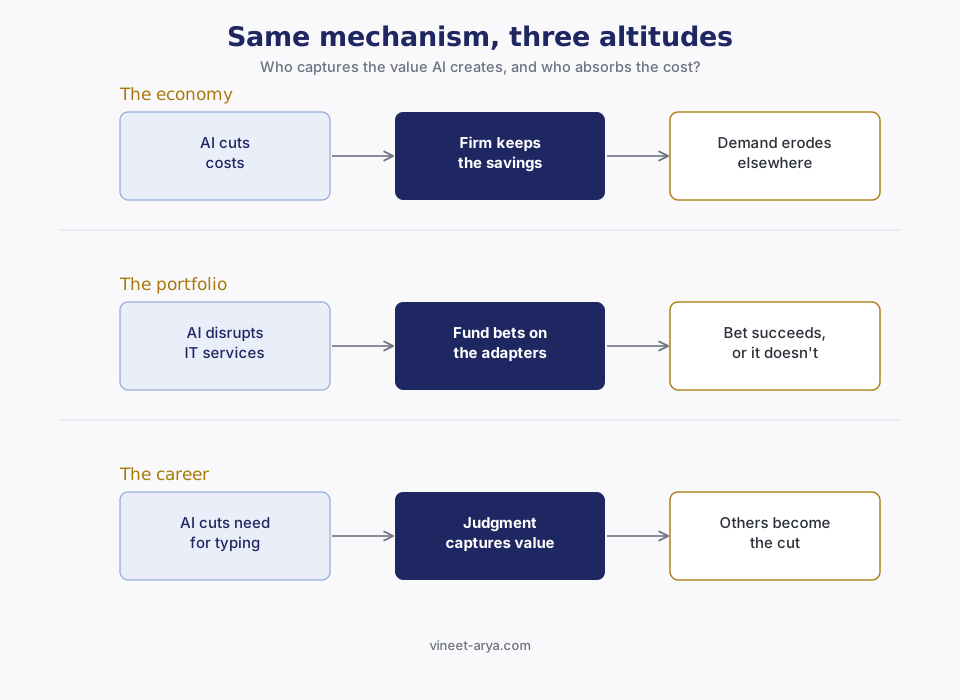
Same mechanism. Three altitudes. At every level, the question is identical: who captures the value AI creates, and who absorbs the cost of it?
What’s still genuinely uncertain
None of this is a settled prediction, and it’s worth being honest about exactly where the uncertainty sits.
PPFAS’s IT bet is live and unproven — Thakkar’s own letter to unitholders is explaining two hard years, not declaring a win. The Wharton paper is a theoretical model of incentives, not a confirmed forecast of what will actually happen to the broader economy. And Ng’s framework, however useful, is also a pitch for a discipline his company happens to teach.
What doesn’t depend on any of those three specific claims turning out to be right is the pattern itself: AI is reliably relocating where value and risk land, at every scale from a single database instance to a national economy. The specific bets — a fund’s allocation, a paper’s policy proposal, an individual’s choice to propose beyond their ticket — are how each of us answers, in practice, which side of that split we’re actually standing on.
That's not a comfortable question. It's the right one.
Sources: Rajeev Thakkar's letter to Parag Parikh Flexi Cap Fund unitholders (August 2026); "The AI Layoff Trap" by Brett Hemenway Falk and Gerry Tsoukalas, Wharton School Research Paper (2026); Andrew Ng, "AI Engineering Skills Map: Shaping the Build."